The Fender Pro Junior amplifier is popular amplifier. It sounds good, is portable and loud enough for smallish gigs (the sort I play for example!) if you don’t want ultra-clean. Unfortunatley it is prone to being noisy – often to the point of unusability – so we did some investigation into the sources of noise in the Pro Junior.
There are two potential sources of noise from the heater supply. Firstly, there is the usual 50 Hz hum from the 6.3 VAC heater supply itself (60 Hz in North America). Secondly, there is also a more insideous noise source which manifests itself as buzz. The source of this noise is quite cryptic, but actually originates from rectifier switching spikes on the HT (aka B+) supply. These spikes contain a large amount of high frequencies. Rectifier spikes couple via stray capacitance into the heater windings, and thence into the pre-amp valves via stray capacitance between the cathode and heaters.
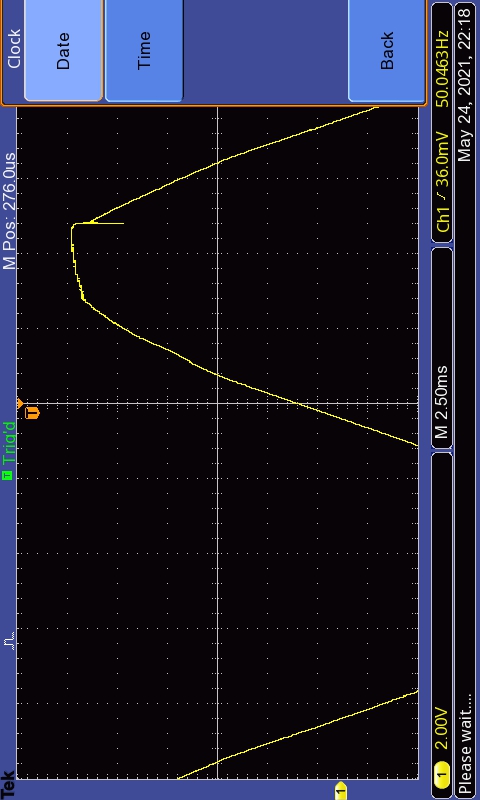
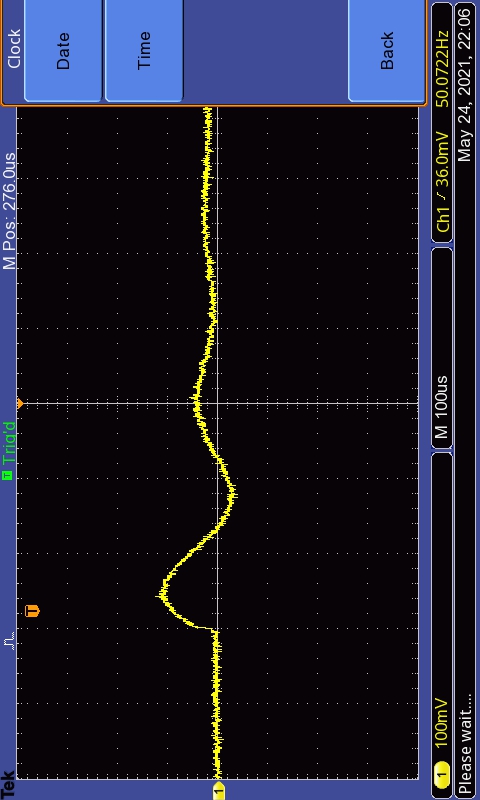
Visualised on an oscilloscope these switching spikes are somewhat obscured by the relative large 50 Hz heater voltage (Fig 1).
Figure 1. Oscillograph of filament supply showing switching spikes induced from the HT (B+) rectifiers switching.
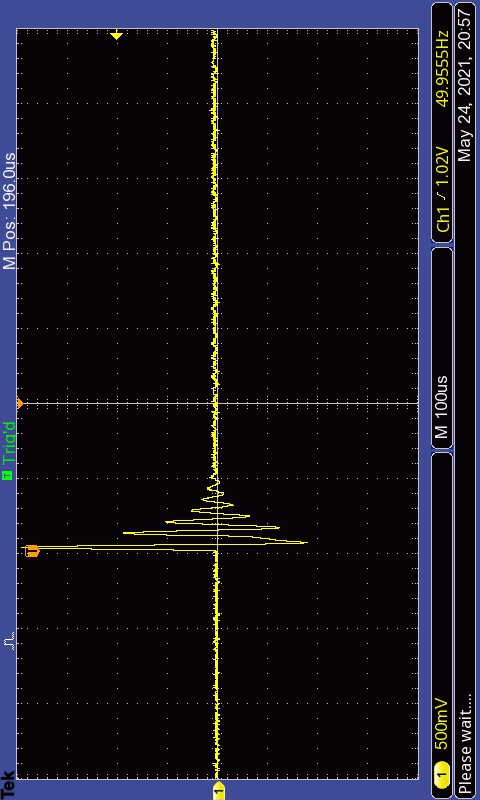
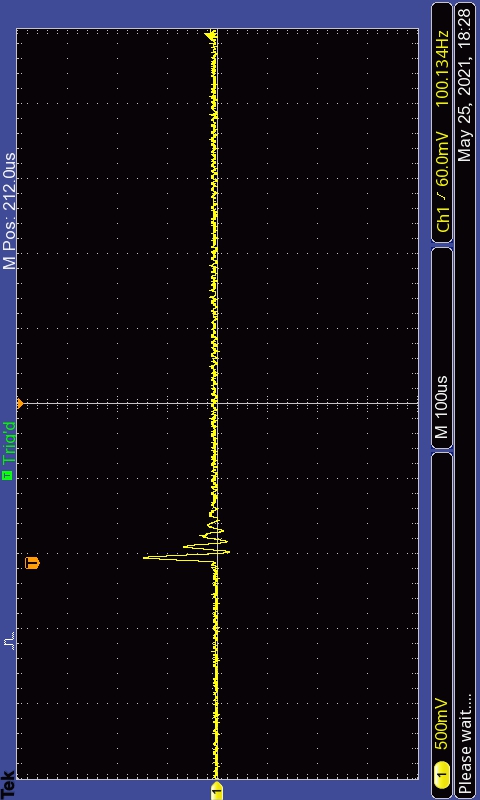
We have employed a technique used by Rod Elliot. to better see the switching spikes. The 50 Hz filament supply is removed by a high pass filter, leaving the switching spikes induced on the heater winding. Fig. 2 shows the switching spikes induced onto the heater winding with the stock 10 nF snubbing caps across the bridge rectifier diodes removed. What you can see is a relatively large initial spike (peak just under 2V, 500 mV / division verticle scale), followed by a damped train of oscillation, a phenomenon referred to as ringing. The very steep rise time indicates a significant high frequency content, which of course does not need much stray capacitance to couple into other windings etc (impedance of a capacitor goes down with frequency).
Figure 2. HT spike from Figure 1 visualized by removing the 50 Hz filament supply using a highpass filter.
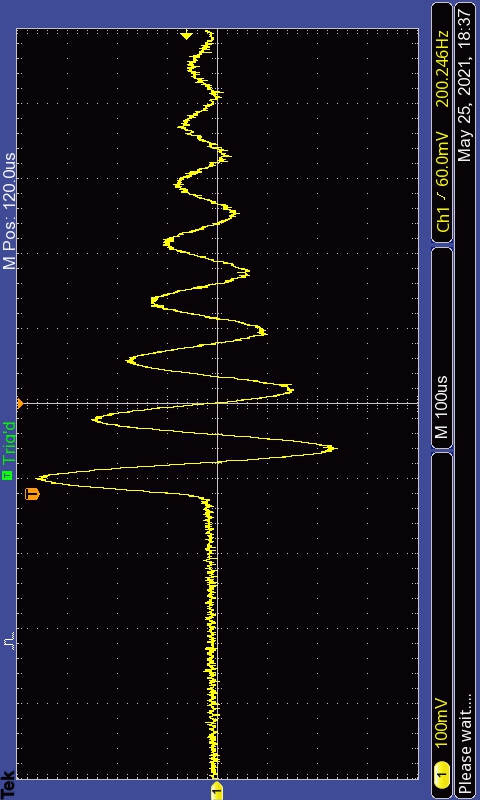
Fig. 3 shows the stock circuit which has 10 nF caps in parallel with the rectifier diode (C19, C20, C21 and C23 in schematic I have). These caps are included to reduce coupling of rectifiers switching spikes into the heaters by not only the magnitude of initial spike, but also the frequency of the subsequent ringing; lower frequencies will induce less noise into the heater winding and should be less insidious. The vertical scale is 100 mV / division (cf 500 mV / division with the unsnubbed rectifier), the first peak is about 380 mV and is not as steep as the unsnubbed ringing.
Figure 3. Lower amplitiude and ringing due to addition of 10 nF snubber caps in parallel with each rectifier diode (stock cricuit)
The extent of the ring is actually not surprising as we have added no resistance to the circuit to damp the resonance, we have simply altered the frequency of the resonance.
Another way to snub a rectifier is to add a Zobel network/s either across each rectifier diode, or across the HT secondary winding. A Zobel network is simply a capacitor and resistor in series, the resistor provide damping by converting the electrical energy in the circuit into heat (this is analagous to mechanical damping). For best results the capacitor and resistor values need to adjusted to the circuit they are being used in, and we tried a variety of values.
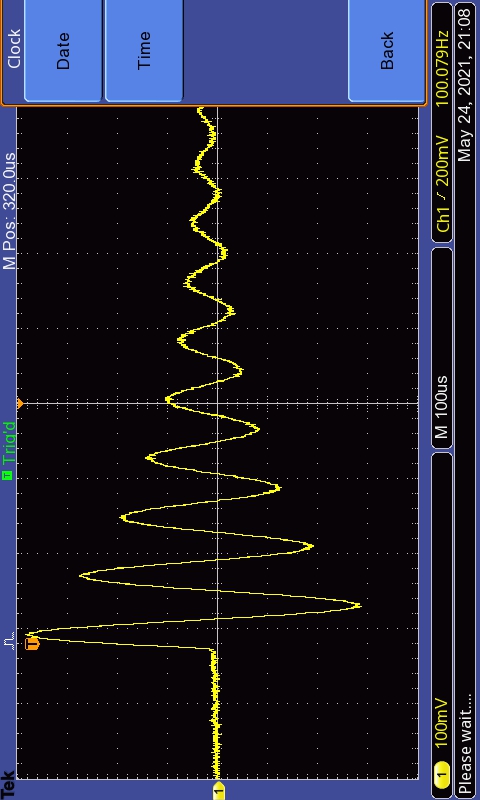
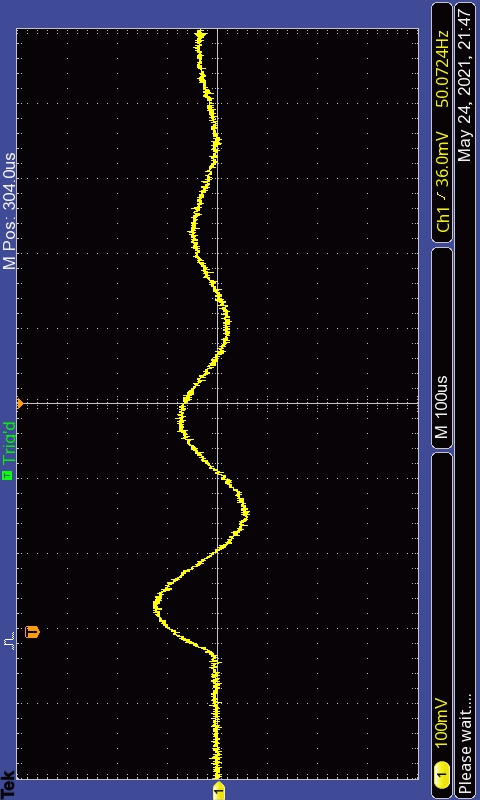
Fig 4 and 5 show results with 100nF / 10 ohm and 100 nF / 100 ohm networks. As we can see these are a massive improvement even on the stock snubber network with 100 nF / 100. Both networks show a lower initial peak. Note 100 mV / divison verticle scale.
Figure 4. Ringing due to addition of 100 nF/10 ohm Zobel network across the HT winding.
Figure 5. Effects of 100 nF / 100 ohm Zobel network. Higher valve resitors ehances damping, at the expense of a sharper initial spike.
Another option is to try some soft recovery diodes in the rectifier. We installed MUR1100 diodes instead of the stock 1N4007s. Fig 6 shows the MUR1100 diodes with no snubbing caps. This is a dramatic improvement on the stock diodes. Note this graph employs the same verticle scale as Fig 2.
Figure 6. MUR1100 diodes instead of the stock 1N4007s. Same scale as Figure 2 shows reduced peak in ringing and lower frequency.
We have added the snubbing caps back in, and get a similar result to the stock diodes; not surprising as the snubber capacitance swamps the diode capacitance (Fig. 7).
Figure 7. Stock 10 nF snubber caps with MUR1100 diodes.
The 100 nF / 100 ohm
diode Zobel network again gives pretty much the same results as with
the stock diodes (not shown).
I have also tested some other capacitor and resistor values, and have managed to reduce the ringing at the expense of increasing the amplitude of the initial spike; I am not yet convinced that the 100 nF / 100 ohm option is optimal.
Two other areas that
seem to improve noise are reducing the current draw of the power
valves (these amps can be biased very hot), and using a hum balance
pot on the filament supply.
We have now designed
a replacement power valves PCB that incorporates a trim pot that can
be adjusted to minimise hum.
Noise can still be a problem, and I guess part of this is due to the layout with unshielded PCB traces running to and from the first valve stages.
The Gallien Krueger MB 150 is a popular bass amp, especially with double bass players. We recently had an MB150 in for repair with a blown mains transformer, GK part No. TTO-10879-02 (equivalent to TTO-10879-01). Unfortunatley, sourcing a replacement was tiresome. The UK distributor quoted 6 months lead time!
I couldn’t find an off-the-shelf mains transformer that would do the job, so got in contact with Tiger Toroids to get a custom unit made. Amazingly, Stephen at Tiger Toroids already had the specs to make a replacement.
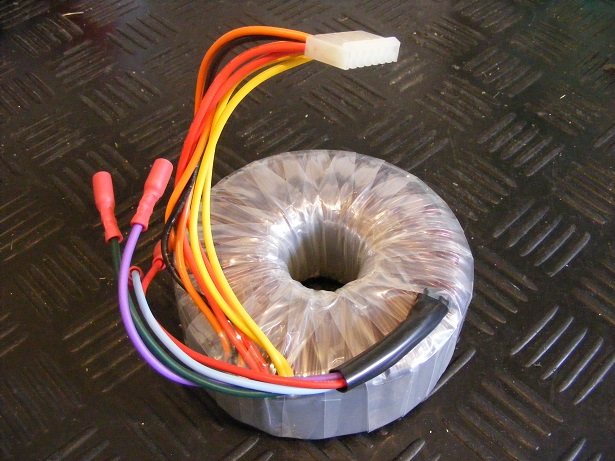
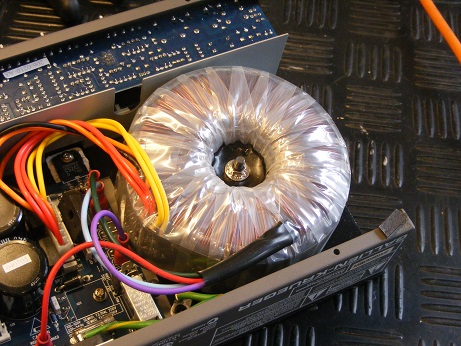
Custom replacement mains transformer for the GK150 made by Tiger Toroids with correct colour coded connectors.
Due to construction contraints, the replacement transformer (see above) is slightly taller than the original (a good thing electrically). However, space in the MB150 chassis is tight, so we could not mount the tranformer safely using the stock mounting plate. You must NEVER allow the mounting bolt through the centre of a toroidal transformer to touch the top and bottom of the chassis; this will make a shorted turn and the transformer will be destroyed in short order.
Mounting transformer with original mounting plate
Thus we filled the transformer centre hole with epoxy potting compound, and drilled a hole for mounting through this. We could now mount the new transformer into the chassis without danger of the bolt touching the both sides of the chassis. If I need to order another MB150 transformer from Tiger Toroids I’ll get them to do the potting.
Centre potted mains transformer now mounts safely in the chassis.
I added a plastic sheet on top of the transformer for extra insulation.
We recently had a MESA Pulse 360 bass amp in our new workshop for repair, with a fault description that it was powering up but not passing any signal.
I’d repaired an M-Pulse 360 last year with a identical fault condition, so we wondered whether the fault in both amps was being caused by the same component failure.
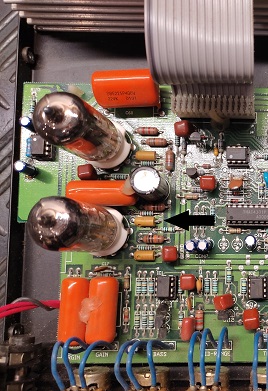
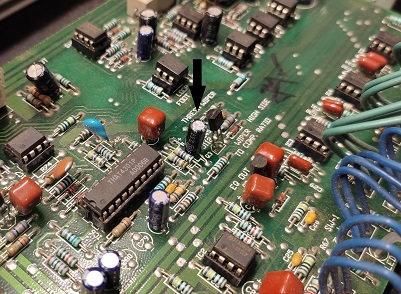
The M-Pulse 360 used tantalum capacitors in several positions in the pre-amp (see figure below). Whilst tantalum capacitiors are considered a “premium” part over standard aluminium electrolytics, they also have a reputation for unreliability. Rod Elliot of Elliot Sound Products has this to say about tantalum capacitors: “while many sing their praises, I do not recommend their use for anything, other than tossing in the (rubbish) bin.”
Arrow pointing to one of the tantalum capacitors in the pre-amp
So why use tantalum capacitors? When compared to aluminimum electrolytics tantalum capacitors can be made smaller for the same capacitance, very useful if PCB space is tight, and have lower equivalent series resistance (ESR) which is useful for decoupling power rails in some applications. However, in this amp PCB space is not at a premium, nor is low ESR a major consideration, and if it was there is space to add a smaller value poly cap in parallel. Some people nay also use them because they are more expensive so must be better………
Anyhow, we openned the amp up and low and behold the same tantalaum cap was shorted as in the other M-Pulse I’d seen! To test the caps I simply unsolder one end and measured the resitance with the multimeter. The cap that has shorted was decoupling the +15 V rail supplying the op-amps in the pre-amp, dragging this rail to ground; without the +15V rail no signal was being passed. We replaced the cap with an aluminium electrolytic and the amp was back up and running.
Arrow showing aluminium cap relacing tantalum cap
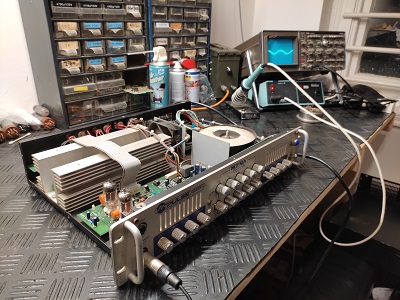
And here is the amp being tested on the bench.
Fixed amp being tested on the bench using “ammo box” dummy load, and analog ‘scope.
The Fender Blues Junior (BJ) is probably Fender’s best-selling valve amplifier.
However, it does have a number of poor design features; in particular the layout of the PCB on which the EL84 power valves are mounted.
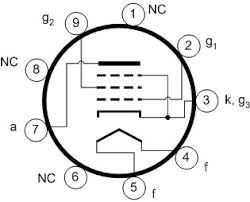
The EL84 is a well-designed valve. The high voltages on the anode (pin 7) and screen grid (pin 9) are located on pins away from the low voltage control grid (pin 2) and the cathode (pin 3).
EL84 pin out
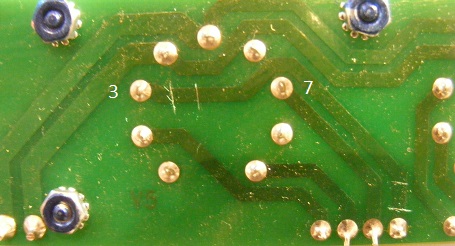
Unfortunately, Fender negate this sensible layout. On the left-hand side EL84 when looking into the back of the amp a PCB trace runs from pin 3 (grounded cathode) between pins 6 and the high voltage anode pin 7. This is a mistake.
Stock Blues Junior PCB. Note PCB trace from Cathode (pin 3) running next to the anode (pin 7)
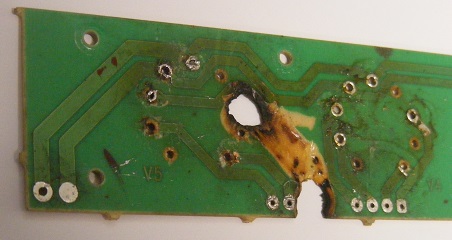
We see many Blue Junior PCBs damaged due to a short from the anode to ground via this errant trace.
Fender BJ PCB damaged by short from pin 7.
Fender address this problem in the current Mk IV version of the BJ by slashing the PCB trace from pin 3 and hard wiring pin 3 directly to the ribbon cable. We now perform this mod on all BJs we get in.
Modification, as used by Fender, for BJ PCBs to stop arcing.
Regardless, given that there are plenty of BJs out there with the older style PCB.
So we designed a replacement PCB that solves this problem.
Our PCB is fabricated from 1.6 mm FR4 (this is a better material than the synthetic resin bonded paper used in the BJ), 2 oz copper traces (1 oz is standard), double-sided, and plated through holes.
JPF Blues Junior replacement PCB showing valve sockets
You can recycle the sockets from your old PCB. Alternatively the PCB accomodates Belton noval sockets.
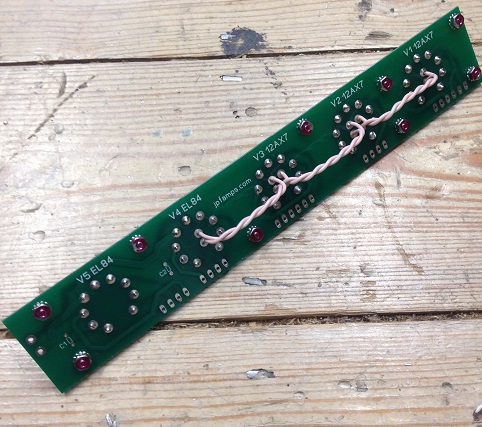
The filament wiring to the pre-amp valves is hard-wired off the PCB with twisted wire. This should help to reduce noise. Again we can supply the PCB with this wire in place.
Filament wiring on JPF Blues Junior PCB.
In addition, there are pads for 2 snubber capacitors (C1 and C2). Fitting these will eliminate the tendency for the BJ to oscillate at around 50 kHz. This of course is not audible, but stresses the valves and the filter caps. We recommend 220 pF, and can supply these. Alternatively, you can change the 47 pF capacitor across the phase inverter to 470 pF. This cap is designated C33 or C14 depending on which version of the BJ you have. 470 pF is the value Fedner now install in the phase inverter to cure oscialltion.
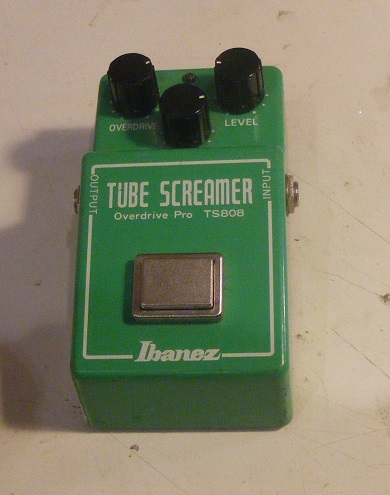
The Ibanez TS-808 Tube Screamer is, rightly, regarded as a classic pedal. Ibanez have now reissued the TS-808. This is fortunate as an original TS-808s will set you back several hundred pounds.
Ibanez TS-808 Reissue
Unfortunately, the switches on the reissue (and indeed the originals), are not that robust.
This pedal came in with a broken switch.
In the past I have simply replaced the whole switch assembly.
However, the only replacement I found for sale was in the US and $20, which, when combined with shipping and import duty, would mke the repair expensive.
I thus investigated whether I could repair the switch.
I removed this from the pedal and disassembled it.
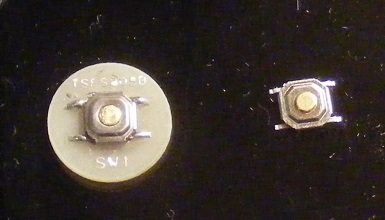
TS-808 momentary switch
On the left we have the defective switch, mounted on a circular PCB.
The replacement on the right is an inexpensive surface mount tactile switch, and it was a simple job to swap out.
Here’s the final switch assembled switch ready for reinstallation in the pedal.
Total cost of the repair £23, which is almost certainly less than the cost of ordering the switch from the US!
Here’s an emergency repair I did for a Leslie 122 cabinet.
The fast / slow relay had died, and I needed to find a solution with parts from Maplins!
The fast / slow replay relay switching is quite interesting in the 122. The cabinet is connected to the organ by a 6 pin connector, however as the audio signal to the cabinet is balanced, there is no spare pin for switching the relay.
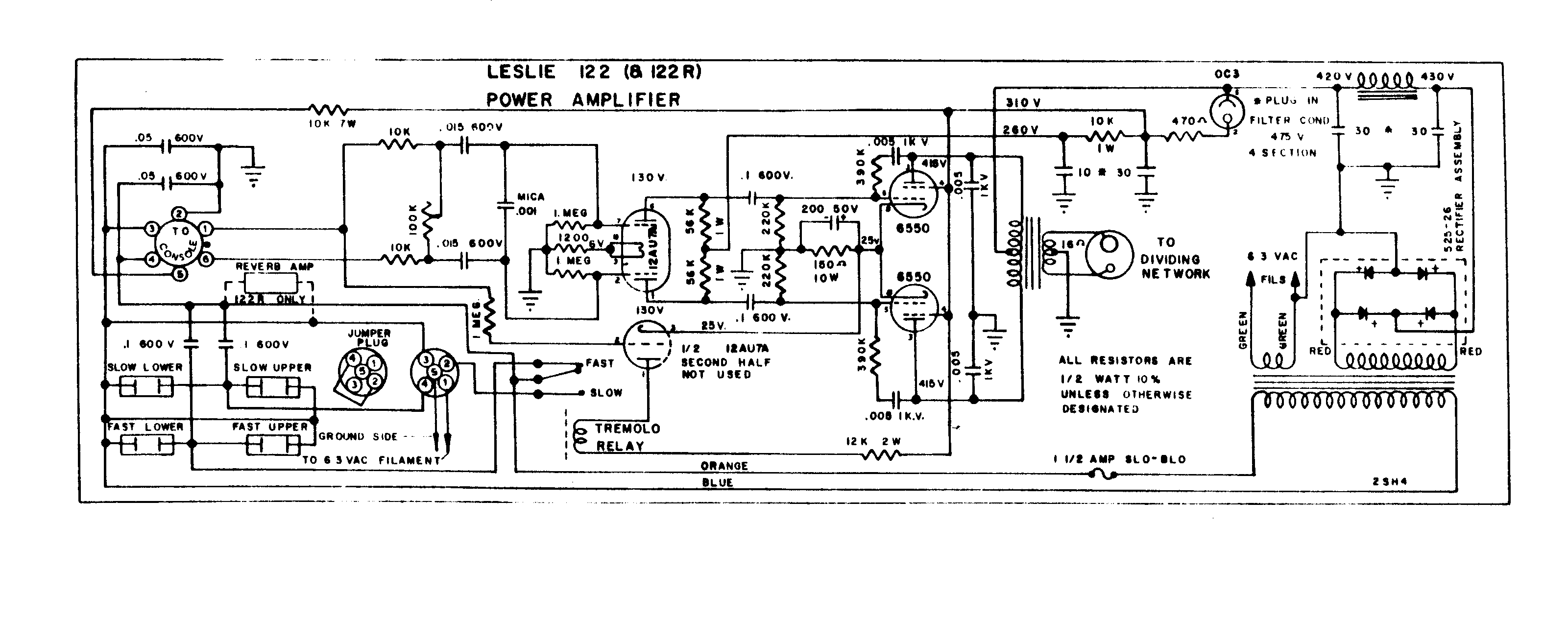
The way around this is that a DC voltage is superimposed on both terminals of the audio signal. As the input is balanced this is a common mode signal and thus not amplified by the 122 (see schematic below).
This DC level is typically 60-100 VDC. This is applied to the grid of a 12AU7 that energizes the relay. The relay had died (due to a Leslie motor shorting out), and needed replacing.
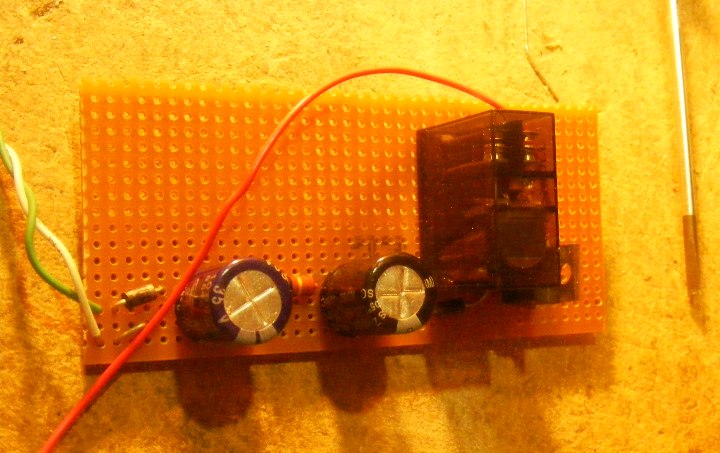
I couldn’t source a direct replacement, so used a DPDT 6V relay which could switch 240VAC at 5 A. As I only needed a SPDT relay I paralleled the two switches for extra current handling.
I derived the power for the relay from the filament supply to the valves in the 122 amplifier; the relay only draw 83 mA which will not have any effect on the filament winding. To switch the relay I used a TIP31 NPN transistor which will turn on when a positive voltage is applied to the base. I limited this voltage with a 47k resistor and a 12V zener.